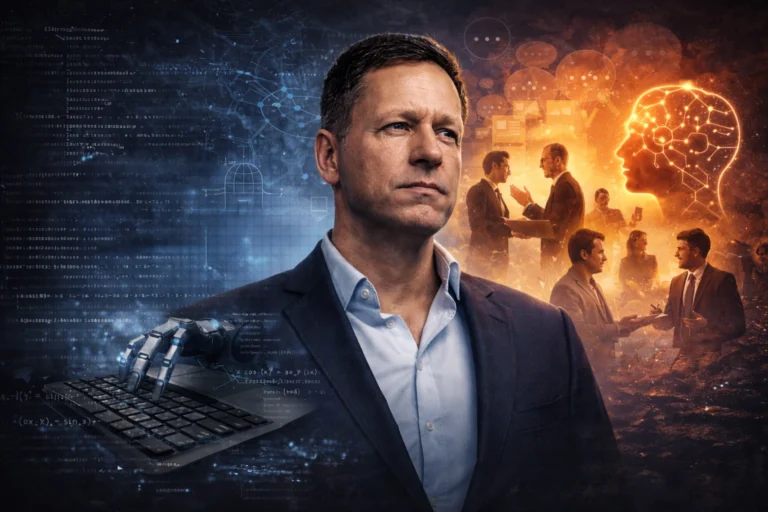

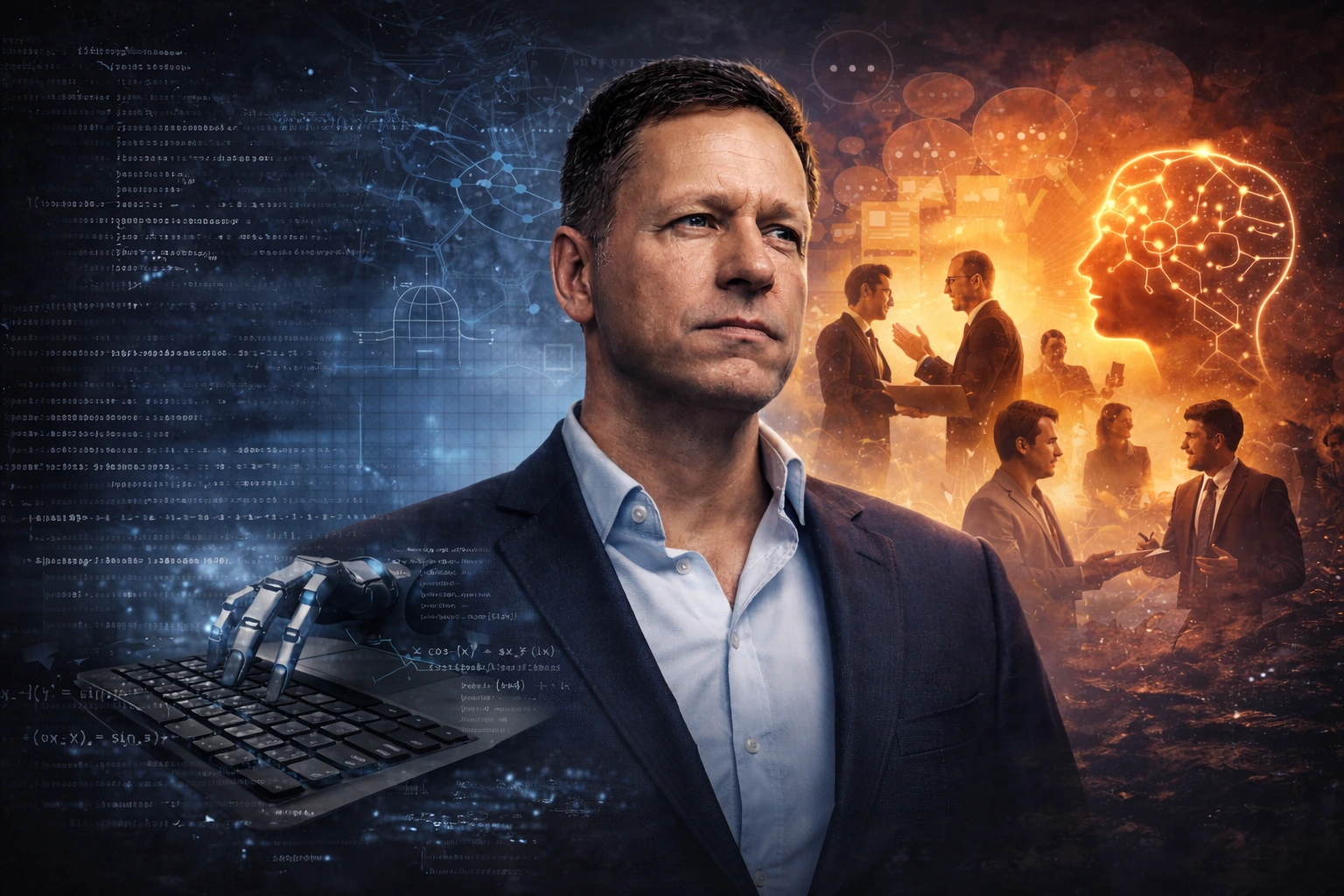
Peter Thiel, the billionaire co-founder of PayPal and chairman of Palantir, has issued a provocative challenge to the tech industry he helped shape. In a discussion that resurfaced and went viral in early 2026, Thiel argues that artificial intelligence is not coming for creative writers, artists, or storytellers first. Instead, it is targeting the group Silicon Valley has worshipped for two decades: the “math people” coders, engineers, quants, data scientists, and algorithmic specialists.
This is no abstract theory. Thiel’s view is rooted in hard evidence of AI’s rapid progress in pure mathematical reasoning, the very skill set that has defined elite tech hiring, high salaries, and prestige for a generation. As machines master complex problem-solving once reserved for the brightest humans, the entire value system of modern technology may be about to shift.
Also in Explained | Anthropic’s Claude AI and Agentic Misalignment: Concerning Behaviors in AI Safety Testing 2026
The Breakthrough Moment: AI Claims Gold at the International Math Olympiad
The tipping point came in July 2025. Google DeepMind’s advanced Gemini model, operating in a specialised “Deep Think” mode, achieved official gold-medal standard at the International Mathematical Olympiad (IMO) the world’s toughest high-school maths competition.
The system solved five out of six problems perfectly, scoring 35 out of 42 points. Unlike earlier AI attempts that needed problems translated into formal code, this version worked directly with natural-language statements and produced clear, human-readable proofs that IMO officials described as “astonishing” in their precision and elegance.
For context, only about 8% of the world’s most gifted young mathematicians reach gold-medal level each year. When a machine can reliably outperform the best teenage mathematicians on problems that require genuine insight and creativity in reasoning, the ceiling on what “math talent” is worth begins to collapse.
Thiel has seen this story before. As a serious chess player in the late 1980s, he viewed the game as the ultimate test of intelligence. Then IBM’s Deep Blue defeated Garry Kasparov in 1997. Chess mastery did not disappear, it simply stopped being a uniquely human pinnacle. Thiel believes mathematics is now following the same path.
Why Math Became the Ultimate Gatekeeper and Why That Era May Be Ending
Thiel traces the modern obsession with mathematical ability back to the French Revolution. Before 1789, verbal eloquence, rhetoric, and classical education were markers of aristocratic privilege. After the revolution, societies sought a new, seemingly meritocratic filter one that could not be inherited through family lineage. Mathematics appeared perfectly suited: abstract, objective, and distributed seemingly at random.
Over the following two centuries, maths became the gatekeeper to power and prestige, from elite university admissions and medical schools to Soviet scientific academies and, later, Silicon Valley’s hiring pipelines.
In the 2010s, this reached its peak. LeetCode grind sessions, whiteboard coding interviews, and algorithmic challenges filtered candidates for one dominant archetype: the pure “math person” who could solve abstract problems under pressure. Six-figure starting salaries for fresh computer-science graduates became the norm. Tech giants and hedge funds competed fiercely for talent that could write flawless code and optimise algorithms.
Thiel asks a pointed question: What does proving you can differentiate under an integral sign really have to do with performing brain surgery, managing a hedge fund, or leading a creative team? In his view, very little. The heavy emphasis on maths served a deeper social function – control. “Math people,” he suggests, often excel at abstraction but can be “singularly clueless about the world,” making them ideal technocrats who rarely question the broader system they serve.
Early Warning Signs: Job Market Shifts and Real-World Cuts
The labour market is already showing the change. LinkedIn’s Skills on the Rise 2026 report reveals that communication, leadership, storytelling, negotiation, and stakeholder engagement skills are appearing roughly twice as often in job postings compared with previous years. These “word people” abilities nuance, persuasion, context, and human synthesis are surging even as pure technical roles face pressure.
Real-world examples are emerging. In February 2026, Block (the company behind Square and Cash App, led by Jack Dorsey) announced it was cutting nearly 40% of its workforce more than 4,000 jobs explicitly crediting AI tools for enabling smaller, more efficient teams. Dorsey stated that “intelligence tools” paired with flatter structures are creating “a new way of working” that fundamentally changes how companies operate.
Even creators of advanced coding assistants have admitted they have not written significant production code themselves in months. The “math moat” that protected high-earning technical roles is evaporating fast. AI does not need general intelligence to replace narrow, rule-based mathematical labour, it only needs to be reliably better at the specific tasks that once defined elite competence.
Who Wins When the Math Moat Crumbles by Peter Thiel’s predictions?
Thiel’s prediction is clear: the advantage is shifting toward the “word people” those skilled in nuance, persuasion, human motivation, storytelling, and connecting ideas across domains. Communicators, strategists, negotiators, and synthesizers possess capabilities that remain stubbornly difficult for pattern-matching systems to fully replicate.
For two decades, liberal-arts graduates were often mocked as pursuing “useless” degrees. The irony is sharp. The very people trained to think critically in prose, build compelling narratives, and read social dynamics may now hold the more durable edge in an AI-augmented world.
This rebalancing goes far beyond individual careers. Entire institutions built around maths supremacy from university computer-science departments with trillion-dollar endowments to tech companies with math-heavy cultures face an existential test. Can they adapt before the foundations crack?
Thiel, who has a long track record of uncomfortable foresight, is betting against rapid adaptation. If he is right, the next decade will not just reorder resumes. It will force a deeper reckoning with what intelligence, merit, and power actually mean when the hardest mathematical problems no longer require a human mind.
A New Era of Human Value
The pedestal Silicon Valley built for its “math priesthood” is wobbling. The real disruption is not merely millions of jobs disappearing, it is the quiet end of an era where pure technical brilliance alone guaranteed success.
In this emerging landscape, the winners will be those who combine deep domain knowledge with irreplaceable human skills: empathy, ethical judgment, creative synthesis, and the ability to inspire and lead. Technology will handle the calculations; humans will provide the wisdom, vision, and connection that machines still cannot replicate.
Peter Thiel’s warning is not a counsel of despair. It is a call to evolve. The future belongs not to those who can solve the most complex equations fastest, but to those who can ask the right questions, tell the most compelling stories, and build the most meaningful systems with or without AI as their partner.
The math era in tech is not over. But its unchallenged dominance is. And for anyone building a career in 2026 and beyond, the message is clear: start investing in the uniquely human skills that no algorithm can yet replace.
Also in Explained | Denmark Proposes Copyright Law to Fight Against the Deepfakes