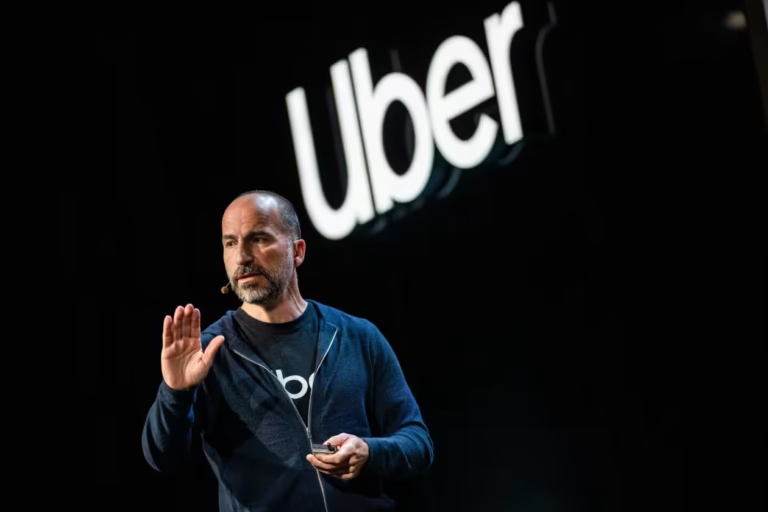

Uber CEO Dara Khosrowshahi has stirred a lively debate across the world with a simple but powerful idea: hard work is not something you are born with, it is a skill you can learn. But once that learning window closes, most people never develop it. Speaking on The Diary of a CEO podcast with Steven Bartlett, the man who rescued Uber from near-collapse delivered a message that feels especially relevant for Sri Lanka’s young, ambitious workforce in 2026.
In a widely circulated summary on X, branding expert Ricar distilled the CEO’s core point: after leading Expedia and now Uber for years, Khosrowshahi says he has never seen a naturally low-effort person truly transform into a relentlessly hard worker.
“The most important skill in life is the skill of working hard,” he said. “It’s not something you can turn on and off. It’s a learned skill. That’s not something you’re born with.”
When asked directly if he had ever witnessed someone change from lazy to driven, his answer was short and honest: “No. No one occurs to me.”
This is not just talk from the top. Khosrowshahi built Uber’s dramatic recovery around exactly this belief.
When he took charge in 2017, Uber was losing almost $3 billion every year. By the end of 2025, the company was generating nearly $10 billion in free cash flow, a turnaround of more than $12 billion. He credits this success to a workplace culture where hard work is expected, practised, and rewarded.
Also in Explained | Could Excessive Screen Time and Algorithms Be Diminishing Our Intelligence?
Uber CEO Khosrowshahi’s Personal Rules of Relentless Effort
The CEO walks the talk. He openly sends work emails on Saturdays. If there is no reply by Sunday, he follows up with a single “?”. Early in his time at Uber, when HR told him his high standards were “scaring people”, his reply was straightforward: “Then they can leave.”
Yet he is careful to separate healthy discipline from burnout. Family dinner from 6 pm to 8 pm is sacred no work allowed. After that, he returns to his desk at 9:30 pm and starts the next day at 5:30 am. His rule is simple: “I’m not going to let anyone outwork me. They may be smarter or more talented, but I’m not going to let anyone outwork me.”
He often points to icons like Cristiano Ronaldo and Michael Jordan. Their greatness, he argues, came less from natural talent and more from building unbreakable habits of discipline and structure through daily repetition.
At Uber, this mindset is baked into the culture. New team members are told clearly: you will work hard, keep improving every day, and take full accountability. Underperformers get honest feedback. If nothing changes, they move on. The company celebrates those who “embrace the grind” while still demanding ethical behaviour.
The Global Debate: Inspiration or Pressure?
Khosrowshahi’s words have divided opinions sharply. Many praise the honesty and the focus on grit, the idea popularised by psychologist Angela Duckworth that perseverance can be developed. They see it as a refreshing reminder that success often comes from consistent effort rather than waiting for motivation.
Others call the approach toxic. They worry it creates fear-driven workplaces, burns people out, and favours short-term results over creativity and long-term innovation. Some argue it puts too much pressure on ordinary employees while top leaders enjoy flexibility and rewards.
In Sri Lanka, where youth unemployment remains a concern and thousands of graduates enter the job market every year, this conversation feels very real. Many young professionals dream of building successful careers in tech, startups, tourism, or the growing digital economy. The question they face is the same: is the ability to work hard something they can still learn, or have they already missed the window?
What Sri Lanka’s Workforce Can Take Away
Sri Lanka has a young, educated population with huge potential. Our entrepreneurs and professionals are already showing strong drive in fields like software development, digital marketing, and renewable energy. Yet in many workplaces, both private companies and government institutions there is still a noticeable gap between talent and consistent execution.
Khosrowshahi’s message offers three practical lessons for Sri Lankans:
- Start building the habit early – Whether you are a university student, a new graduate, or someone switching careers, the time to develop discipline is now. Small daily choices waking up at the same time, finishing tasks before deadlines, and pushing through when motivation fades build that “muscle” of hard work.
- Create your own structure – You do not need to copy Uber’s intensity. Set clear personal rules like protected family time, fixed working hours, and regular review of your goals. Many successful Sri Lankan business leaders already follow similar routines without burning out.
- Choose environments that expect excellence – Look for teams and companies that reward effort and improvement. In Sri Lanka’s growing startup scene and foreign-invested firms, those who consistently deliver are the ones who rise fastest.
At the same time, Sri Lankan culture values balance, family, relationships, and wellbeing. Khosrowshahi’s own example shows that hard work does not mean 24/7 grinding. It means refusing to be outworked during the hours you have committed to your goals.
The Choice Is Yours
Dara Khosrowshahi’s blunt view leaves us with a clear question: are you actively learning the skill of hard work, or are you quietly accepting that it is not for you?
In Sri Lanka today, with new opportunities opening in the digital economy, renewable energy, and global outsourcing, those who choose to develop the habit of relentless, smart effort will have a real advantage. The ones who wait for motivation or blame the system may find themselves watching others move ahead.
The good news? You do not need to be born with it. You can start building it today, one focused hour, one completed task, one honest self-review at a time.
Whether you agree with Khosrowshahi’s philosophy or not, the results at Uber prove that cultures built on disciplined hard work can achieve remarkable turnarounds. For Sri Lanka’s next generation of leaders, professionals, and entrepreneurs, the same principle applies.
The window is still open. The choice is yours.
Also in Explained | Denmark Proposes Copyright Law to Fight Against the Deepfakes