
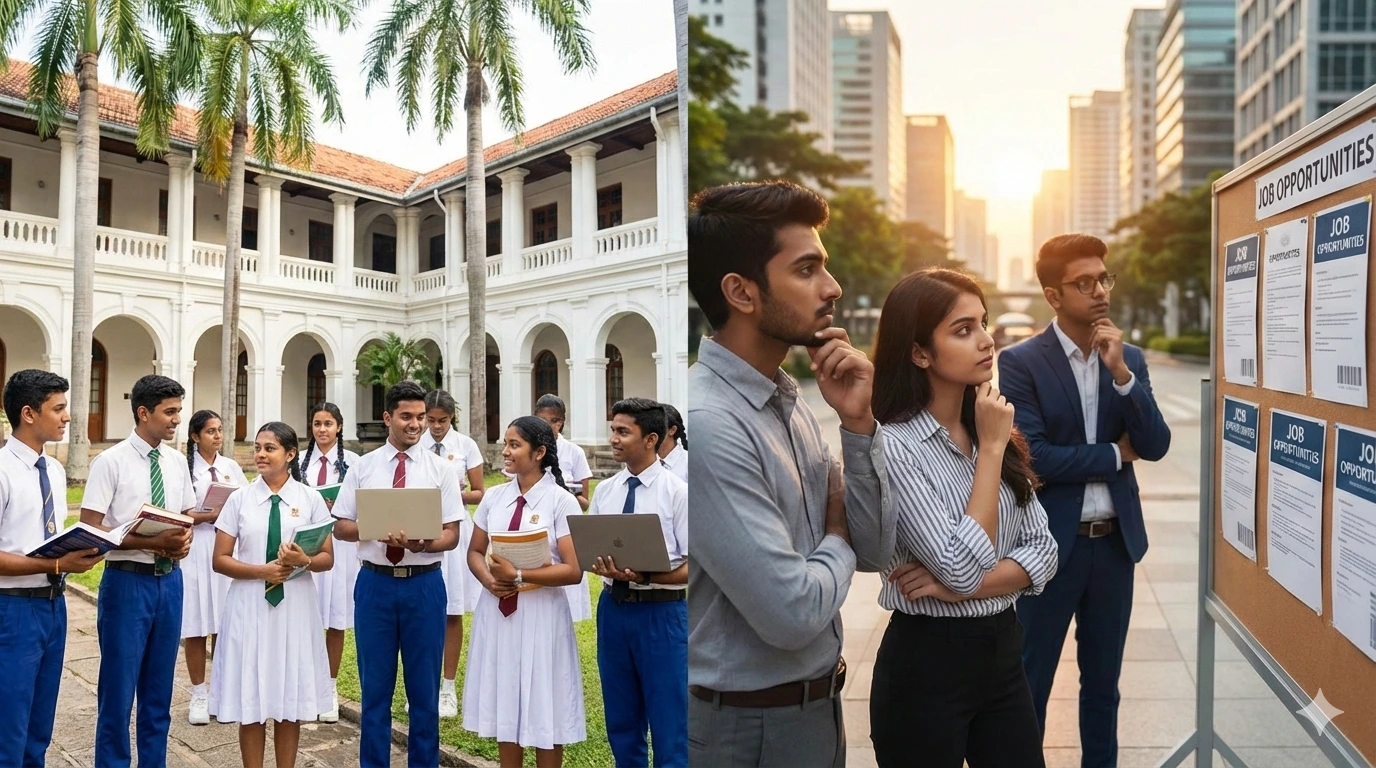
Many people outside or even within Sri Lanka are unaware of the country’s remarkable education achievements. With a literacy rate exceeding 92% (adult) and near 99% for youth, free education from kindergarten to university, and compulsory schooling up to age 14, Sri Lanka boasts one of Asia’s most accessible and equitable systems. This foundation has produced globally competitive talents in fields like IT, engineering, and innovation.
Yet, paradoxically, youth unemployment hovers around 20% in 2025, with graduates often struggling to find suitable jobs. This evergreen paradox high human capital alongside employment challenges sparks ongoing interest, searches like “Sri Lanka education system facts” or “why unemployment in educated Sri Lanka,” and shares among diaspora, educators, and policymakers.
Also in Explained | Sri Lanka’s Brain Drain Crisis: The Cost of Losing Our Brightest Minds
Sri Lanka’s Impressive Education Legacy
Sri Lanka’s commitment to education dates back decades, yielding standout outcomes:
- High Literacy Rates: The adult literacy rate stands at approximately 92.7% (latest available data from 2023–2025), with youth (ages 15–24) literacy nearing 99%. These figures place Sri Lanka among the top in South Asia, far above regional averages.
- Free Education Policy: Introduced in 1945 and expanded post-independence, education is free from primary through tertiary levels, including textbooks and often uniforms. University education is state-funded, enabling access regardless of income.
- Compulsory Education: Schooling is mandatory from ages 5 to 14 (up to Grade 9), ensuring broad foundational coverage. Over 10,000 government schools serve millions of students.
- Universal Access Achievements: Near-universal primary enrollment and high secondary completion rates reflect decades of investment, contributing to Sri Lanka’s strong human development indicators.
These policies have democratized opportunity, producing a highly educated population that surprises many who associate developing nations with lower attainment.
Talents and Hidden Strengths
Sri Lanka’s education system has nurtured remarkable capabilities often overlooked:
- IT and Digital Prowess: Despite challenges, Sri Lankans excel in software development, freelancing platforms (e.g., Upwork), and tech startups. The country ranks highly in global outsourcing indices, with talents powering international firms.
- Global Competitiveness: Graduates in engineering, medicine, and sciences contribute worldwide, evident in diaspora success in Silicon Valley, Australia, and Europe.
- Innovation and Resilience: High mathematical and scientific aptitude (seen in Olympiad performances) and English proficiency among educated youth fuel potential in knowledge economies.
- Cultural Emphasis on Learning: Deep-rooted value for education drives parental sacrifices, resulting in a workforce that is disciplined and adaptable.
These strengths position Sri Lanka as a hidden gem for human capital.
The Paradox: Why Unemployment Persists
Despite these assets, unemployment particularly among youth and graduates remains a daily struggle:
- Youth Unemployment Rates: In Q1 2025, youth (15–24) unemployment was 19.7%; it rose to 20.8% in Q2 the highest among age groups, versus an overall rate of 3.8%.
- Graduate Challenges: Many arts and humanities graduates face underemployment due to oversupply and limited public-sector openings.
- Skills Mismatch: Education emphasizes theory over practical, vocational, or digital skills. Employers cite gaps in soft skills, industry experience, and emerging technologies.
- Structural Issues: Slow private-sector growth, preference for government jobs, and post-crisis recovery delays limit opportunities. NEET rates (youth not in education, employment, or training) add to the concern.
This mismatch means educated youth often migrate (brain drain) or accept roles below their potential.
Bridging the Gap: Pathways Forward
Addressing the paradox requires targeted reforms:
- Modernize curricula with vocational training, digital skills, and internships.
- Incentivize private-sector job creation in IT, tourism, and manufacturing.
- Promote entrepreneurship through funding and mentorship.
- Enhance career guidance to align choices with market needs.
With these, Sri Lanka can fully harness its educated talents for inclusive growth.
Celebrating and Building on Strengths
Sri Lanka’s education successes high literacy, free access, and nurtured talents are achievements to celebrate, often underappreciated globally. Yet the unemployment challenge reminds us that quality and relevance matter as much as access.
By evolving the system to match modern demands, Sri Lanka can transform its human capital into a driver of prosperity. Informed citizens, policymakers, and educators play key roles in this journey.
Also in Explained | Still Searching for Greener Pastures: Why Sri Lankans Are Continuing to Leave Home