
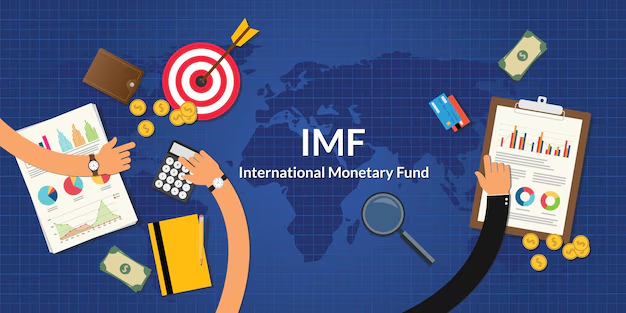
The International Monetary Fund (IMF) is a global organization that works to promote economic stability and growth worldwide. Established in 1944 at the Bretton Woods Conference, it now has 191 member countries. Headquartered in Washington, D.C., the IMF is governed by its members through a Board of Governors and an Executive Board, with a Managing Director leading daily operations.
For ordinary people around the world families managing budgets, workers relying on stable jobs, or small business owners navigating trade the IMF plays a behind-the-scenes role in keeping economies steady. It provides policy advice, financial support during crises, and technical help to build stronger systems. While not a household name like a bank, its work affects exchange rates, inflation, and opportunities in member countries.
This overview explains the IMF’s purpose, functions, lending practices, and role in debt management, using straightforward facts from its operations.
Also in Explained | Pension Rights Clarification for Public Officers Appointed After 2016: Ensuring Retirement Security in Sri Lanka
History and Purpose
The IMF was created after World War II to prevent economic crises like those in the 1930s, which worsened the Great Depression. Its founders aimed for a system of international cooperation on money matters.
The IMF’s core goals include:
- Promoting global monetary cooperation.
- Securing financial stability.
- Facilitating international trade.
- Supporting sustainable economic growth and high employment.
- Reducing poverty.
It achieves this through three main activities: surveillance (monitoring economies), lending (providing financial assistance), and capacity development (offering training and advice).
Member countries contribute funds based on quotas reflecting their economic size. These resources allow the IMF to lend during difficulties, while governance ensures accountability to all members.
Surveillance: Monitoring Global Economies
The IMF regularly reviews each member’s economy through “Article IV” consultations. It assesses policies, risks, and stability, offering advice to prevent problems.
This surveillance covers global trends too, like exchange rates or financial spillovers. Benefits include early warnings helping countries adjust before crises and shared insights promoting better policies worldwide.
For the public, this means indirect stability: sound advice can prevent sudden job losses or price spikes from economic shocks.
Lending: Financial Support During Crises
The IMF provides loans when countries face balance of payments problems shortages of foreign currency for imports or debt payments. Assistance creates “breathing room” to implement reforms restoring growth.
Lending comes from member quotas or special trusts. Facilities vary:
- Stand-By Arrangements for short-term needs.
- Extended Fund Facility for longer structural issues.
- Rapid instruments for urgent crises.
- Precautionary lines for strong economies as insurance.
Loans carry conditions policy changes like fiscal adjustments or reforms to ensure repayment and sustainability. The IMF tailors programs to circumstances, focusing on growth and protection for vulnerable groups.
Countries request help voluntarily; approval involves Board review. Repayment occurs over years, with interest.
Benefits include crisis resolution, restored confidence, and access to other financing. Many nations have used IMF support to recover from shocks, like pandemics or commodity slumps.
Debt Management: Sustainability and Challenges
The IMF plays a key role in debt issues. It conducts Debt Sustainability Analyses to assess risks and advise prevention.
Lending requires debt to be sustainable (or made so through reforms/restructuring). Programs combine adjustments with growth measures, improving transparency and resilience.
Benefits for countries: early risk identification, financing during distress, and support for restructurings restoring viability.
Challenges arise too loans add to debt (though concessional for low-income nations), and conditions require tough reforms. The IMF collaborates with creditors for fair burden-sharing, emphasizing responsible borrowing and lending.
Capacity Development: Building Stronger Institutions
Beyond money, the IMF offers technical assistance and training helping central banks, finance ministries, and statisticians improve skills.
This builds long-term capacity: better tax systems, financial oversight, or data collection. For citizens, stronger institutions mean efficient services and stable economies.
A Balanced View: Benefits and Considerations
The IMF helps maintain global stability preventing crises that could spread unemployment or poverty. Lending has supported recoveries in numerous countries, while advice promotes sound policies.
Debt aspects require care: programs aim for sustainability, but reforms can be demanding short-term. The IMF evolves, incorporating social spending protections and climate considerations.
Public views often focus on outcomes: successful support brings growth; challenges spark debate on conditionality.
The IMF’s Role in Today’s World
The IMF remains vital for cooperative solutions in an interconnected economy. It fosters stability benefiting everyday lives steady jobs, affordable goods, opportunities.
For member countries, engagement means access to expertise and resources during need, alongside shared responsibility for global prosperity.
As economies face ongoing challenges, the IMF’s work rooted in cooperation supports resilient, inclusive growth worldwide.
Also in Explained | Inflation Edges Up to 2.9%: The Real Extra Cost Hitting Sri Lankan Family Budgets