
Sri Lanka financial system stability 2026 presents an unusual but important picture. The people responsible for managing risk inside banks, finance companies, insurers and other financial institutions say they have greater confidence in the stability of the financial system, yet they are simultaneously becoming more worried about risks coming from the global economy. That is not a contradiction. It suggests that Sri Lanka’s financial sector may be becoming stronger internally at exactly the moment when the next serious test could arrive from outside.
The Central Bank of Sri Lanka released the findings of its second-half 2026 Systemic Risk Survey on 7 October. The survey covered 158 institutions and achieved a 100% response rate, with participants including risk officers from licensed banks, finance companies, insurers, primary dealers, unit trusts, stockbrokers, microfinance companies, rating agencies, financial-infrastructure providers and mobile-based e-money providers. Importantly, CBSL states clearly that the results represent the perceptions of survey respondents and do not necessarily reflect the views or forecasts of the Central Bank itself.
Sri Lanka Financial System Stability 2026: Confidence Is Improving
The first message from the survey is encouraging. Respondents reported higher confidence in financial-system stability over both the next one year and the next three years compared with the previous survey round. CBSL describes this as improved sentiment towards the stability of the financial system, continuing a remarkable recovery from the very weak confidence levels seen during the economic crisis.
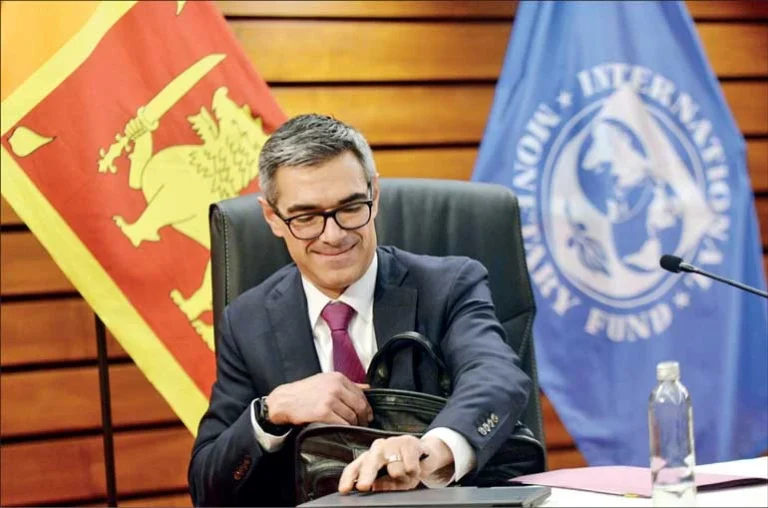
There are understandable reasons for that change in sentiment. In its September assessment, the IMF described Sri Lankan banks as well capitalised and profitable, while official reserves had risen to US$6.9 billion at end-August and debt restructuring was largely completed. CBSL has also reported stronger economic activity and an external sector that, despite considerable pressure earlier in the year, returned to a current-account surplus in August.
None of this means risk has disappeared. It means financial institutions appear more confident that the domestic system itself is capable of continuing to function even if conditions become difficult. That is an important difference from 2022, when sovereign stress, foreign-exchange shortages, inflation and economic contraction were occurring together and confidence in the broader financial environment had deteriorated sharply.
The Biggest Change Is Where the Risk Is Coming From
The more interesting part of the survey is the shift in what respondents believe could threaten that stability. In the first half of 2026, global macroeconomic risks accounted for 14% of the risk distribution. In the second half, that share rose to 26%, making global macroeconomic conditions the most prominent risk category identified by respondents.
CBSL says this increase largely reflected concern about geopolitical tensions, possible spillovers from other countries and uncertainty surrounding the global economic outlook. The timing matters because the survey was carried out from 17 July to 14 August 2026, when institutions were already dealing with the economic effects of heightened Middle East tensions and uncertainty around energy prices.
| Risk category | H1 2026 | H2 2026 | Change |
|---|---|---|---|
| Global macroeconomic risks | 14.0% | 26.0% | +12.0 pp |
| Fiscal and sovereign-related risks | 15.4% | 12.3% | -3.1 pp |
| General domestic macroeconomic risks | 17.6% | 16.6% | -1.0 pp |
| Financial infrastructure risks | 9.3% | 12.5% | +3.2 pp |
| Financial market risks | 15.7% | 14.0% | -1.7 pp |
| Risks related to financial institutions | 19.4% | 14.1% | -5.3 pp |
| General risks | 8.7% | 4.6% | -4.1 pp |
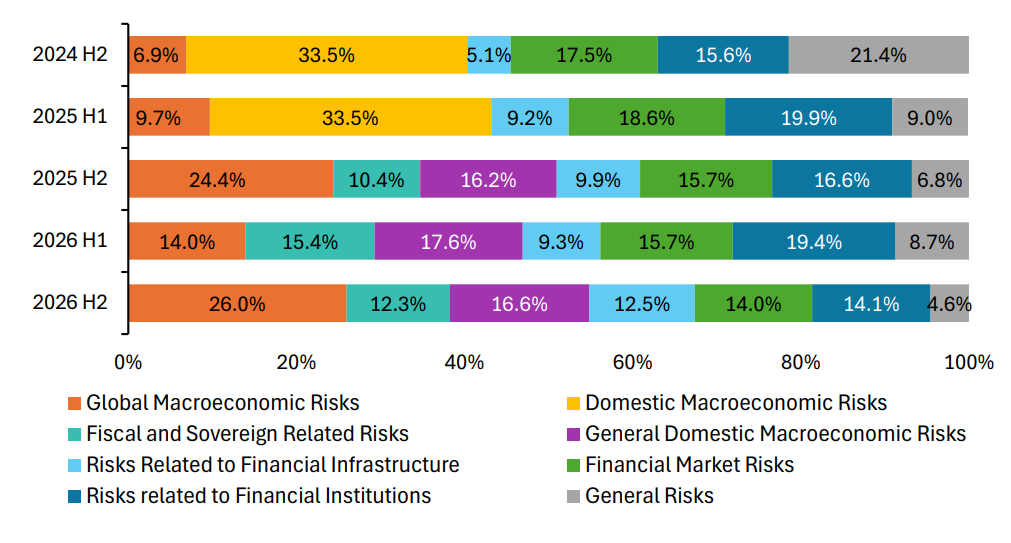
The table tells an important story. Risks directly associated with financial institutions themselves fell noticeably as a share of perceived systemic risk, while global risks almost doubled. The financial system is therefore not being described by its own participants as becoming internally weaker; instead, they appear increasingly concerned about what could happen when external shocks move through an otherwise more stable domestic system.
How Does an External Shock Reach a Sri Lankan Bank?
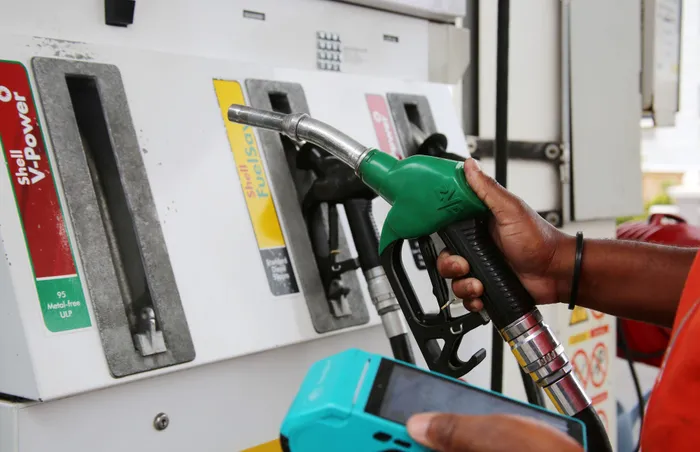
The transmission can begin far away from a bank branch. Imagine that another international conflict pushes oil prices sharply higher. Sri Lanka’s import bill rises, demand for foreign currency increases and fuel becomes more expensive for businesses and households.
That energy shock can then move through the economy. A transport company faces higher diesel costs, a manufacturer pays more for production and logistics, and households spend a larger share of income on essentials. If inflation rises, monetary policy may need to stay tighter for longer, keeping borrowing costs higher than businesses and households would prefer.
The bank becomes involved at the final stages of this chain. A company facing higher costs may struggle to service a loan, while a household dealing with more expensive food, transport and utilities may find mortgage, leasing or credit repayments harder to maintain. In that way, an external shock that begins with geopolitics or commodity prices can eventually become a question of asset quality and repayment capacity inside Sri Lanka’s financial system.
This is the central point behind the Ceylon Public Affairs assessment. Sri Lanka’s next financial-stability challenge may be less about an obvious weakness inside bank balance sheets and more about whether those balance sheets can withstand the indirect pressure produced when global shocks weaken the customers borrowing from them.
Exchange Rates Are Another Transmission Channel
Currency pressure can produce a similar chain. A global shock that weakens foreign-exchange inflows or increases the cost of imports may place depreciation pressure on the rupee. A flexible exchange rate helps the economy adjust and protects reserves from being used simply to defend a fixed currency value, but depreciation also makes imported goods and foreign-currency obligations more expensive in rupee terms.
This can affect businesses very differently depending on how they earn and spend foreign currency. An exporter earning dollars may be relatively protected, while an importer with mainly rupee income can face a much larger cost increase. Companies with foreign-currency obligations but limited foreign-currency revenue can also become more exposed when the exchange rate moves sharply.
Banks therefore need to watch more than their own direct foreign-exchange positions. They also need to understand the currency exposure of their borrowers, particularly businesses whose repayment ability depends heavily on imported inputs, global commodity prices or foreign-currency debt.
Rising Confidence Does Not Mean Respondents Expect a Risk-Free Year
There is another finding that deserves careful attention. Survey participants perceived a slight increase in the short-term probability of a high-impact negative event affecting financial-system stability compared with the previous survey round. At the same time, their perceived probability over the next three years declined slightly.
That combination is revealing. Respondents can believe that the financial system is fundamentally stronger while also believing that the next twelve months contain more immediate uncertainty. A person can be confident that a well-built house is structurally sound while still being more concerned because a storm is approaching; the condition of the house and the probability of bad weather are two different questions.
This distinction is particularly important when interpreting the survey publicly. It would be inaccurate to say CBSL predicts a major financial event, because it does not. The survey records the perceptions of financial-sector participants during a specific period, using categories ranging from very low to very high probability, and CBSL explicitly separates those perceptions from its own institutional views.
The Survey Is a Warning System, Not a Forecast
The Systemic Risk Survey has been conducted twice a year since 2017 by CBSL‘s Macroprudential Surveillance Department. Its purpose is to understand how financial-sector participants see risks and how confident they are about system stability. The 2026 H2 exercise assessed seven major risk categories containing 46 sub-risks, making it useful as an early-warning tool for changes in sentiment across the financial system.
However, perception surveys have limitations. Respondents can overestimate risks that are receiving intense attention at the time of the survey and underestimate risks that are less visible. The July–August survey period also means the results should not automatically be treated as a real-time reading of conditions in October, because markets, geopolitics and domestic policy can change between the survey window and publication.
Its real value therefore lies less in predicting a specific crisis and more in identifying where professional attention is shifting. In H2 2026, that shift is unmistakably towards the global environment.
Strong Banks Still Need Strong Borrowers
Financial stability is sometimes discussed as though keeping banks safe is mainly about making banks hold enough capital. Capital buffers are essential because they allow institutions to absorb losses, and the IMF’s description of Sri Lankan banks as well capitalised is therefore reassuring. Yet capital alone cannot prevent a broad deterioration in loan quality if a large external shock damages businesses and households across the economy.
This is why financial stability and the real economy cannot be separated. A healthy bank needs customers who can repay their loans, firms that can continue operating and households whose incomes can absorb normal financial obligations. If energy prices, inflation or interest rates place too much pressure on those customers, the stress eventually returns to the lender.
The best defence is therefore not simply stronger regulation after borrowers get into difficulty. It is also a macroeconomic environment that limits extreme volatility, allows the exchange rate to adjust in an orderly manner, keeps inflation expectations anchored and builds enough external reserves to reduce the risk of another foreign-exchange shortage.
Policymakers Should Watch the Connections, Not Only the Institutions
The next phase of macroprudential policy should therefore pay close attention to the links between global shocks and domestic credit quality. Banks and finance companies can stress-test borrowers against higher fuel prices, interest rates and currency movements rather than relying only on normal economic assumptions. Regulators can monitor whether rapid credit growth is becoming concentrated in sectors particularly exposed to imported costs or global demand.
The same principle applies to households. Stronger consumer-credit assessment becomes particularly important when living costs are rising because a borrower who appears able to service debt under today’s expenditure pattern may become vulnerable after a sharp increase in fuel, food or utility costs. Financial consumer protection and prudent lending are therefore part of systemic resilience, not merely separate social concerns.
Sri Lanka should also continue building the external buffers that reduce the intensity of shock transmission. Higher reserves cannot prevent global oil prices from increasing, but they can reduce the probability that an energy shock turns into a foreign-exchange shortage. Credible monetary and fiscal policy cannot eliminate geopolitical conflict, but they can reduce the risk that external volatility becomes a domestic confidence crisis.
The Financial System Looks Stronger; the Environment Around It Looks Harder
The most useful conclusion from the 2026 H2 Systemic Risk Survey is therefore more balanced than either “banks are safe” or “financial risk is rising”. Financial-sector participants are more confident in system stability, and their concern about risks directly related to financial institutions has fallen. At the same time, global macroeconomic risk has become the largest perceived source of systemic risk, rising sharply from 14% to 26%.
That combination may actually describe the next stage of Sri Lanka’s recovery very well. The domestic financial system has moved a long way from the conditions of the crisis, but stronger internal foundations do not make the country immune to oil shocks, global interest-rate movements, exchange-rate pressure or weaker external demand. What matters now is whether those stronger foundations are sufficient to prevent an external shock from becoming a new domestic financial problem.
For banks, that means watching the financial health of their customers as carefully as their own balance sheets. For policymakers, it means continuing to build reserves, control inflation, maintain credible macroeconomic policy and monitor how global shocks move through households and businesses. The next financial-stability test may not begin inside a Sri Lankan bank at all; it may begin thousands of kilometres away and only become a banking problem after it reaches the people expected to repay their loans.
This Ceylon Public Affairs analysis is based primarily on the Central Bank of Sri Lanka’s Systemic Risk Survey for H2 2026, released on 7 October 2026, with contextual information from official CBSL and IMF sources. The survey records respondents’ perceptions during 17 July–14 August 2026 and does not represent a CBSL forecast of a financial crisis or high-impact event.