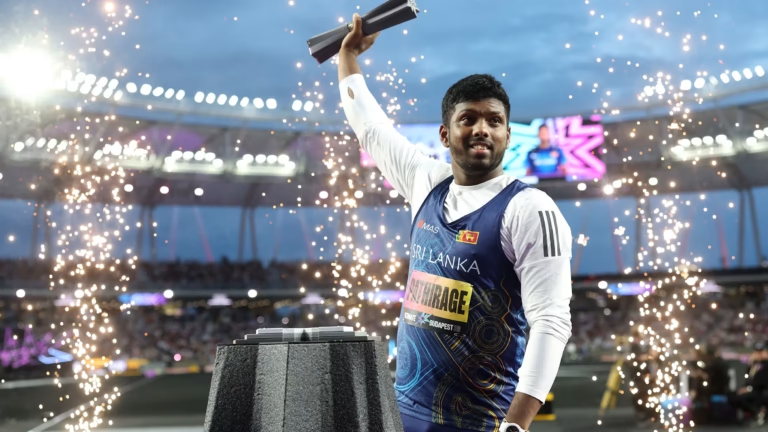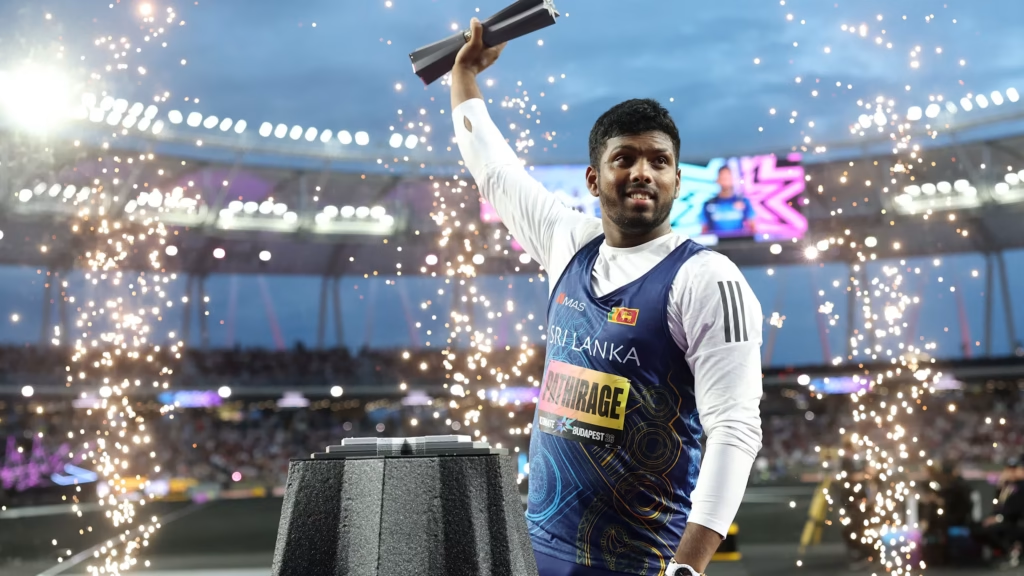

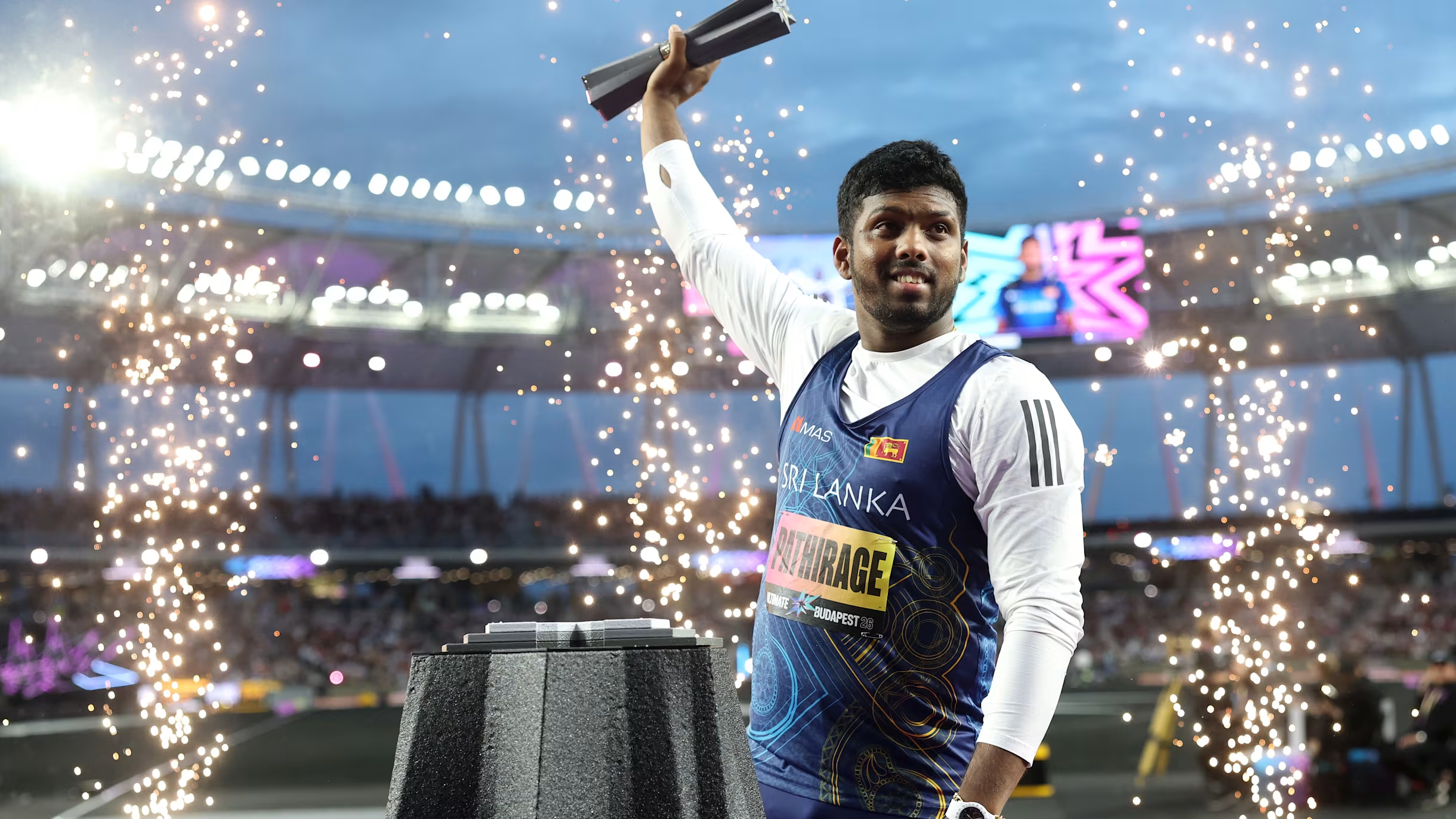
Rumesh Tharanga Pathirage is no longer simply one of Sri Lanka’s most promising athletes. At 23, he has become the World No.1-ranked men’s javelin thrower, Sri Lanka’s first Diamond Trophy winner in the event, Commonwealth Games champion and, as of 13 September, the inaugural World Athletics Ultimate Champion.
That transformation has happened remarkably quickly. At the 2025 World Athletics Championships in Tokyo, Pathirage reached his first senior World Championships final and finished seventh with 84.38 metres. One year later, he is repeatedly beating Olympic champions, world champions and athletes who have defined international javelin for the past decade.
Sri Lanka has spent generations talking about identifying another athlete capable of reaching an Olympic podium. In Rumesh, that conversation has changed. The talent has already been identified. The performances have already arrived. The responsibility now is to build a professional system capable of carrying that talent safely and consistently towards Los Angeles 2028.
Rumesh Tharanga Pathirage: A Season That Changed His Status
The numbers from 2026 explain why Rumesh must now be treated differently.
He began the year with an 89.37m throw at Diyagama in March, already demonstrating a level that would make him internationally competitive. By 4 June in Rome, the breakthrough became global: 92.62 metres, a Sri Lankan national record and the best throw in the world this season.
That Rome throw broke a Golden Gala meeting record that had stood for 20 years. World Athletics placed him eighth on the world all-time list and second among Asian men historically, behind only Pakistan’s Olympic champion Arshad Nadeem. It was also the longest javelin throw recorded anywhere since the Paris 2024 Olympic final.
And it was not an isolated performance.
He won the Ostrava Golden Spike with 86.57m and then defeated a world-class field in Doha with 88.68m. At the Commonwealth Games in Glasgow on 31 July, he produced 89.75m to win gold ahead of Neeraj Chopra, Yash Vir Singh, Anderson Peters and former Olympic champion Keshorn Walcott.
The Commonwealth victory was significant enough for the Sri Lanka Air Force, which Rumesh represents, to promote him from Corporal to Sergeant. His long-time coach, retired Warrant Officer Tony Prasanna, and support staff were also formally recognised for their contribution.
Then came another extraordinary month.
Rumesh won in Lausanne with 88.14m before throwing 92.07m in Zürich on 27 August, just 55 centimetres below his national record. Eight days later, at the Wanda Diamond League Final in Brussels, he threw 89.04m to win the men’s javelin title and become Sri Lanka’s first Diamond Trophy winner.
And the season still was not finished.
On 13 September in Budapest, at the first-ever World Athletics Ultimate Championship, Rumesh produced 91.09m on his final attempt to defeat two-time world champion Anderson Peters and European champion Julian Weber. The victory made him the inaugural Ultimate Champion and earned him the event’s US$150,000 winner’s prize.
By mid-September, the World Athletics season list told an extraordinary story. The three longest men’s javelin throws recorded anywhere in 2026 were all his: 92.62m, 92.07m and 91.09m.
This is no longer potential. This is elite-level consistency.
From a Cricket Ball to a Javelin
Perhaps the most Sri Lankan part of Rumesh’s story is that javelin was not originally the obvious destination.
He began athletics at Sri Palee College in Horana and also developed as a cricketer. In an earlier interview, he recalled playing representative cricket and later moving to St. Peter’s College after Tony Prasanna recognised his throwing ability. Prasanna would ultimately become the coach most closely associated with his transformation into an international javelin thrower.
There was already evidence of the raw material. The explosive shoulder action and arm speed that helped him as a fast bowler could be redirected towards throwing. Over time, cricket and discus gave way to javelin until the event became his full sporting focus.
Progress was not instantaneous. Rumesh competed at junior level, won the 2024 Asian Throwing Championships with 85.45m and then reached the World Championships final in 2025. What happened in 2026 was therefore not a sporting miracle that appeared from nowhere. It was the acceleration of a development pathway already several years in the making.
That matters because athletes like Rumesh are often celebrated only once they become internationally visible.
By then, years of coaching, family sacrifice, institutional support and personal discipline have already happened out of public view.
Sri Lanka Already Has an Olympic Programme Around Him
The next stage should not be framed as though Sri Lankan authorities have done nothing.
Rumesh is already part of the Department of Sports Development’s Mission Olympics 2028 – Journey to the Rings programme and has been identified as a Tier 1 athlete. The Government’s high-performance framework provides monthly support for elite athletes and coaches, with additional provisions for overseas training and foreign coaching.
He has also received an IOC Olympic Solidarity Scholarship for Los Angeles 2028 through the National Olympic Committee of Sri Lanka. The programme is intended to support training, international competition, coaching, medical services and long-term Olympic preparation.
The Air Force has provided employment, sporting support and recognition, while private-sector sponsorship has also entered his Olympic journey.
These are important foundations.
But his 2026 performances have changed the scale of what is now required.
A development programme designed for an athlete trying to reach Olympic qualification is not necessarily sufficient for the current World No.1 preparing to challenge for Olympic gold.
The LA28 Plan Should Now Be Individual, Not Generic
Elite javelin is exceptionally demanding on the shoulder, elbow, lower back, knees and entire kinetic chain. Three seasons remain before Los Angeles, and the priority cannot simply be to keep asking Rumesh to throw 90 metres every few weeks.
The objective must be arriving in July 2028 healthy, technically stable and capable of producing his best throw during an Olympic final.
That requires an individual high-performance plan built around Rumesh and coach Tony Prasanna rather than forcing them to fit entirely inside a generic national programme.
Sports medicine should be continuous, not reactive. Biomechanical analysis should track changes in his run-up, delivery angle, blocking mechanics and throwing load. Strength and conditioning, physiotherapy, nutrition, recovery and psychological preparation should operate as one team with his coach.
His competition calendar should also be performance-led. Diamond League events and major championships provide essential exposure, but every additional competition creates travel and physical load. The national objective should not be to make him appear at every available event simply because he is now successful.
Sometimes the best support an elite athlete can receive is permission not to compete.
World-Class Equipment and Logistics Are Part of Performance
A 90-metre javelin thrower also cannot be supported as though equipment were an incidental expense.
Different javelins behave differently depending on their design, stiffness, aerodynamic characteristics and wind conditions. Elite athletes need access to suitable competition and training implements, along with reliable transportation and replacement arrangements.
Travel planning matters too. A European Diamond League season can involve repeated flights, transfers, hotels, visas and equipment transport while the athlete is simultaneously managing training and recovery.
These may sound like administrative details compared with coaching. At world level, they are performance variables.
The athlete should therefore have a small permanent management structure responsible for competition entries, travel, equipment, medical coordination and commercial commitments so that he and his coach are not forced to become administrators between major championships.
Los Angeles Is Close Enough to Plan for Now
The Los Angeles 2028 men’s javelin qualification round is scheduled for 21 July 2028, with the Olympic final on 24 July at the Los Angeles Memorial Coliseum. World Athletics has approved the broad qualification principle for LA28, with approximately 40% of places expected to come through entry standards and 60% through world rankings, although the final event standards are still to be formally established.
For Rumesh, the discussion should no longer be narrowly about whether he can qualify. His current performances place him among the very best throwers in the world.
Olympic javelin remains unpredictable. Neeraj Chopra, Arshad Nadeem, Anderson Peters, Julian Weber, Keshorn Walcott and a new generation of throwers ensure that nobody can responsibly promise a medal more than a year in advance, let alone two.
But Sri Lanka has something it very rarely possesses: an athlete whose present performance level is already comparable with Olympic medal-winning distance.
That opportunity should be treated accordingly.
We Have Been Here Only Twice Before
Sri Lanka’s Olympic athletics history is exceptionally small.
Duncan White won silver in the 400m hurdles at London 1948. Susanthika Jayasinghe won silver in the women’s 200m from Sydney 2000 after the subsequent reallocation of medals. Those remain Sri Lanka’s only Olympic medals in athletics. Rumesh now has the opportunity to write another chapter.
That should not become pressure placed unnecessarily on a 23-year-old athlete. Sri Lanka’s role should be to remove avoidable obstacles around him, not add the emotional burden that he must somehow “save” national sport. The best form of national encouragement is practical.
Fund the coaching team properly. Protect his health. Give him world-class equipment. Guarantee access to sports science. Make international travel seamless. Secure quality training environments. Allow his coach to control the performance programme. Bring in specialist expertise where it adds value without breaking a partnership that is already producing world-leading results.
Most importantly, maintain that support when he has an ordinary competition.
Elite sport is not linear. A thrower capable of 92 metres will still have difficult evenings, injuries and technical periods where results temporarily fall. Sri Lanka must learn to support the athlete between victories, not only celebrate him after them.
Rumesh Has Already Done the Hardest Part
A country can build stadiums, appoint committees and create Olympic programmes. It cannot manufacture a 92.62-metre arm.
Rumesh Tharanga Pathirage has already supplied the part Sri Lanka cannot create through policy: extraordinary sporting ability, discipline and the capacity to perform against the best athletes in the world.
His coach has helped turn that ability into repeatable international performance. His family, the Air Force, sporting authorities, Olympic structures and sponsors have all contributed to the journey.
Now the opportunity is unusually clear. Sri Lanka does not need to search for an athlete who might one day become internationally competitive in men’s javelin.
He is already World No.1.
The next two years should therefore be less about discovering Rumesh and more about protecting what has already been discovered. If Sri Lanka can build the right high-performance environment around him, Los Angeles 2028 becomes more than another Olympic participation story.
It becomes a genuine opportunity to compete for something this country has waited decades to see again: a Sri Lankan athlete standing on an Olympic athletics podium. And perhaps, for the first time, standing on its highest step.
This profile and public-affairs analysis is based on World Athletics, Wanda Diamond League, Department of Sports Development, National Olympic Committee of Sri Lanka and Sri Lanka Air Force records reviewed up to 15 September 2026. Olympic qualification standards for LA28 have not yet been finalised, and no Olympic medal outcome can be guaranteed.