

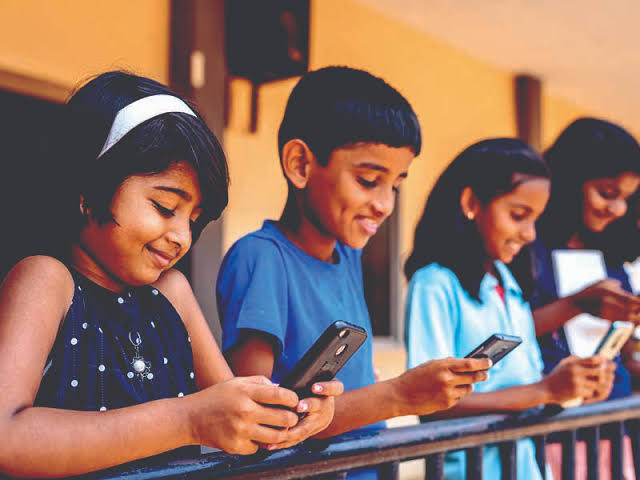
Social media addiction in children is often discussed as though the problem begins and ends with a child who refuses to put down a phone. A parent says, “Stop scrolling.” The child says, “Just five more minutes.” Half an hour later, another video is playing, another notification has arrived and the phone is still in their hand.
It is easy to call this poor discipline, but a recent UNICEF explanation offers a more useful way of understanding what is happening. Social-media platforms commonly use features such as infinite scroll, autoplay, notifications, likes, views and streaks because these features encourage users to stay longer and return more often. Children are not simply facing a screen; they are interacting with systems specifically designed to compete for their attention.
That does not mean every child who enjoys social media is “addicted”. UNICEF’s expert guidance is more careful than that. The bigger concern is whether social-media use begins to interfere with sleep, schoolwork, exercise, family life, friendships or other activities that children need in order to develop well.
Social Media Addiction in Children Is Not Only About Self-Control
Imagine opening an app and seeing one interesting video. When it ends, another begins automatically. You do not have to search for it, press anything or make a decision, because the next piece of content is already waiting.
Then another appears.
Infinite scroll works in a similar way. There is no final page telling the user that they have reached the end, which removes a natural moment when someone might otherwise decide to stop. UNICEF digital-parenting expert Dr Jacqueline Nesi explains that features such as infinite feeds, autoplay, notifications and numerical rewards like likes, views and streaks make both children and adults more likely to remain on platforms longer.
| Common feature | What it does | Why stopping may become harder |
|---|---|---|
| Infinite scroll | Keeps adding new posts | There is no natural ending point |
| Autoplay | Starts the next video automatically | The user does not have to choose to continue |
| Notifications | Pull attention back to the app | Creates repeated reasons to check the phone |
| Likes and views | Give visible social feedback | Children may keep checking for reactions |
| Streaks | Reward repeated daily activity | Missing a day can feel like losing progress |
The important lesson is that a young person is not always making a fresh, conscious decision every few seconds to continue scrolling. The platform has reduced the number of moments when the user has to decide whether to stay. That makes the discussion about screen habits very different from simply telling children to “use some willpower”.
The Algorithm Learns What Keeps You Watching
Most social-media feeds are not random. As someone watches, skips, likes, comments or spends longer on particular content, the platform can learn which material is more likely to hold that person’s attention. UNICEF explains that many social-media algorithms are designed around increasing engagement and time spent on the platform.
This does not make algorithms automatically harmful. The same technology could recommend educational, useful or age-appropriate material, and social media can help young people communicate, learn and find communities around genuine interests. The concern is that engagement and child wellbeing are not always the same goal, and content that keeps somebody watching is not automatically content that is good for them.
This is one reason parents asking how social media affects children’s attention span should look beyond the total number of hours on a device. The type of content, the speed at which it changes, why the child keeps returning and what other activities are being displaced can matter just as much as the clock.
Why Children May Find It Harder to Stop
Adults struggle with the same designs, but children are not simply smaller adults. Self-control develops over time, and UNICEF notes that children are still developing the ability to regulate their own behaviour. Adolescents may also be particularly sensitive to social rewards such as likes, views and responses from friends.
There is another part of this that parents sometimes underestimate. Social media may be where a child’s friends are talking, sharing jokes, discussing school and making plans, so switching off can feel less like putting down entertainment and more like leaving a room where everybody else is still talking. UNICEF points out that children and teenagers can therefore experience genuine concern about feeling excluded from peer interaction.
This is why rules work better when adults understand what a child is actually doing online. A teenager spending two hours speaking with close friends is not having exactly the same experience as another teenager spending two hours endlessly moving through algorithmic short videos. Both may require boundaries, but they are not automatically the same problem.
When Does Heavy Use Become a Real Problem?
Parents often search for signs of social media addiction in children, but it is important not to diagnose a child simply because they enjoy being online. UNICEF suggests looking at whether social-media use is causing serious problems in the child’s wider life and whether they are unable to stop despite those problems.
A useful starting point is displacement. If scrolling regularly replaces sleep, homework, physical activity, face-to-face relationships or other important parts of childhood, the family has a reason to pay attention. The issue becomes more serious when arguments about the phone are constant, school responsibilities are repeatedly ignored or a child appears unable to reduce their use even when they recognise that it is affecting them.
| Ask this question | Why it matters |
|---|---|
| Is sleep being reduced? | Sleep is essential for learning, mood and health |
| Is schoolwork regularly delayed? | Social media may be replacing necessary study time |
| Has physical activity dropped? | Online time should not remove movement from daily life |
| Are offline relationships suffering? | Children still need direct social interaction |
| Can the child stop when needed? | Difficulty stopping despite problems deserves attention |
These questions are more useful than declaring that every young person with a phone has an addiction. UNICEF stresses that the effect of social media varies significantly from one child to another, and children already dealing with emotional or mental-health difficulties may be more vulnerable than others.
Parents Cannot Solve a Design Problem With Punishment Alone
Taking away the phone may sometimes be necessary, particularly at night or during study time, but punishment alone teaches very little about how digital systems work. A child who receives the device again without understanding why it was so difficult to stop may simply return to exactly the same pattern.
UNICEF recommends beginning with communication. Parents can ask what keeps the child online, explain how autoplay, notifications and endless feeds are designed, and discuss what activities are being pushed aside. The aim is not to shame children for being influenced by technology that was intentionally built to hold attention.
For families searching how to reduce social media addiction in children, three areas are particularly useful: conversation, boundaries and example. Boundaries may cover how long social media is used, which parts of the day are phone-free, what content is appropriate and who children are allowed to communicate with. Parents also need to look at their own habits because children learn a great deal from watching how adults use phones at meals, during conversations and before sleep.
Family Rules Work Better When Children Understand Them
A rule such as “no phones after 9pm” is easier to follow when the child understands that the purpose is protecting sleep rather than simply exercising parental control. Families can decide together which spaces remain device-free, such as the dining table, bedrooms at night or periods set aside for homework. UNICEF recommends building rules on communication and giving children some voice in the discussion rather than creating every restriction without explanation.
| Possible family rule | What it protects |
|---|---|
| Phones outside bedrooms at night | Sleep |
| No social media during homework | Concentration |
| Device-free meals | Family conversation |
| Notifications switched off during study | Uninterrupted attention |
| Agreed daily limits | Time for exercise, reading and other activities |
The exact rules will differ between a nine-year-old and a seventeen-year-old. They will also differ between families, because schoolwork, communication needs and maturity are not the same for every child. What matters is creating deliberate habits instead of allowing an algorithm to decide how every free minute is spent.
Schools Have a Role Too
This debate also belongs inside education policy. Students increasingly use devices for research, communication and learning, meaning schools cannot simply pretend digital life disappears at the classroom door. At the same time, education systems need to protect the long periods of attention required for reading, solving problems and understanding difficult ideas.
Ceylon Public Affairs has already examined Sweden’s rethink of screen-heavy education, where policymakers have been reconsidering the balance between digital tools and traditional learning. The wider debate around Sri Lanka’s education system should include the same question: are students learning how to control technology, or are we assuming that simply giving them access to more technology automatically improves education?
Digital literacy should therefore include attention literacy. Children should understand why a notification feels urgent, how recommendation systems learn their behaviour and why free apps may still have a strong commercial interest in keeping users engaged for as long as possible.
Parents Should Not Carry the Whole Burden
Perhaps the most important point in UNICEF’s guidance appears towards the end. Keeping children safe online should not be left entirely to families, because parents are trying to manage powerful technologies without the kind of mature safety systems that exist around many other products children use. UNICEF argues that technology companies and regulators also carry responsibility for creating safer environments for young users.
That is a public-policy issue. Age-appropriate design, safer default settings, clear controls, privacy protections and limits on manipulative features deserve serious discussion when services are used heavily by children. If a product is designed to maximise attention, it is unrealistic to place all responsibility on a twelve-year-old for resisting that design perfectly.
The goal should not be to frighten parents into removing children completely from digital life. Social media can connect, educate and entertain, and it is now part of the social environment in which many children grow up. The challenge is ensuring that the technology remains something a child uses rather than something that quietly begins deciding how the child spends their time.
The Most Valuable Skill May Be Knowing When to Stop
A generation growing up with social media needs more than instructions about passwords, strangers and online privacy. Children also need to understand that their attention has value, that platforms compete for it and that feeling the urge to check one more video or notification is not always accidental.
Parents can help by talking openly, creating realistic limits and showing the same discipline themselves. Schools can protect focused learning and teach children how digital systems influence behaviour, while regulators and technology companies need to accept responsibility for the environments they create.
The question is therefore bigger than how many hours a child spends looking at a screen. It is whether that child can still choose when to stop, sleep properly, finish difficult work, read without constant interruption, spend time with other people and enjoy parts of life that do not produce a notification.
If we want children to grow up in control of technology, teaching them how technology competes for their attention may be one of the most important digital skills we can give them.
This article is for public-awareness and educational purposes. Its main source is UNICEF’s digital-parenting guidance featuring Dr Jacqueline Nesi, reviewed on 22 September 2026. Heavy social-media use should not automatically be described as a clinical addiction, and parents concerned about a child’s mental health or behaviour should seek appropriate professional advice.