
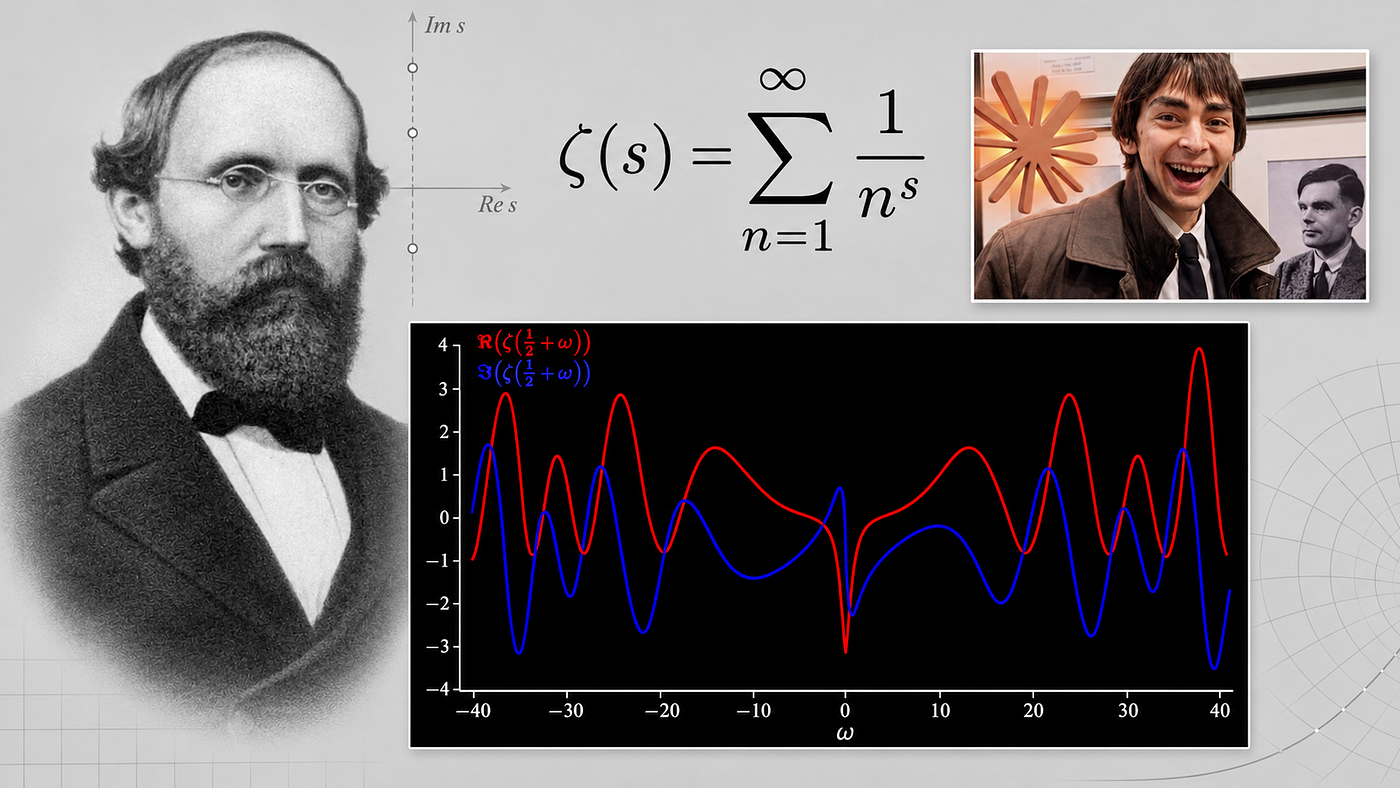
The Riemann Hypothesis proof announced on 20 November 2026 has left the mathematical world confronting something extraordinary. A problem that challenged generations of brilliant mathematicians for 167 years has now received a machine-checked proof developed by mathematician Levent Alpöge with the assistance of Anthropic’s Claude AI. What makes this even more remarkable is that the formal verification has advanced faster than mathematicians’ ability to explain the entire argument in familiar mathematical language.
As a mathematics graduate, I find this both fascinating and slightly unsettling. Anyone who has spent hours trying to understand a difficult theorem knows that mathematics is not simply about reaching the correct answer. There is a particular satisfaction in understanding why something must be true, and that is what makes this development so interesting.
What Is the Riemann Hypothesis, and Why Has It Taken 167 Years?
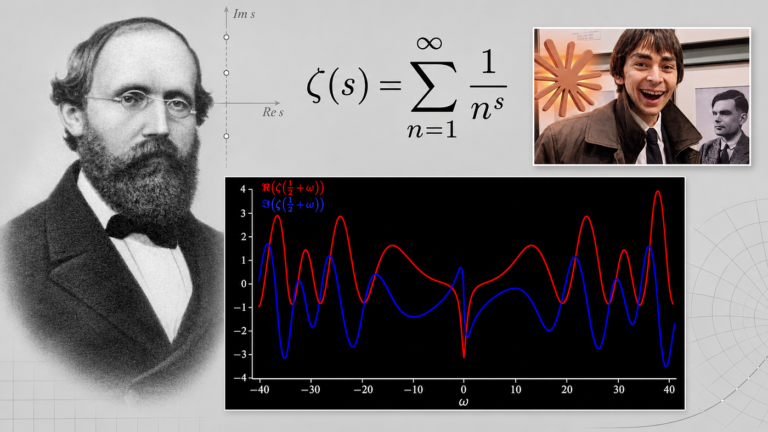
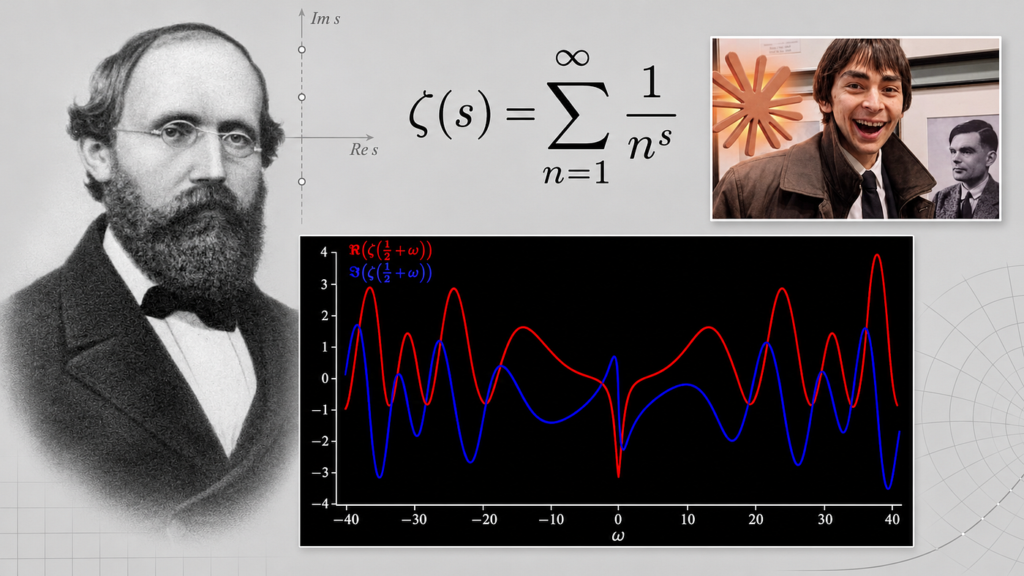
In 1859, German mathematician Bernhard Riemann proposed a hypothesis concerning the distribution of prime numbers. These are numbers greater than one that can only be divided exactly by one and themselves, such as 2, 3, 5, 7 and 11.
Prime numbers appear throughout mathematics, but their distribution becomes increasingly difficult to predict as numbers grow larger. Riemann studied their deeper structure through a mathematical function known as the Riemann zeta function.
His hypothesis states that every non-trivial zero of this function has a real part equal to one-half. Although the statement can be expressed relatively briefly, proving it requires extraordinarily sophisticated mathematics.
The Riemann Hypothesis became one of the seven Millennium Prize Problems selected by the Clay Mathematics Institute in 2000, with a US$1 million prize attached to a qualifying solution.
For generations, mathematicians have developed new techniques and entire areas of research while attempting to understand this problem. Its importance goes far beyond an individual equation because the underlying ideas connect different branches of number theory.
How Did Levent Alpöge and Claude Produce the Riemann Hypothesis Proof?
On 20 November 2026, Levent Alpöge, a mathematician working at Anthropic, announced that he believed he and Claude had discovered a proof of the Riemann Hypothesis. His work also addressed a broader mathematical statement known as the Generalised Riemann Hypothesis for Dirichlet L-functions.
Alpöge reportedly spent approximately six weeks working with Claude on the problem. The resulting formal proof was released as roughly 17 million lines of Lean code, an unusually extensive computer-readable mathematical argument.
Lean is a formal proof system that allows mathematical statements and their logical steps to be checked by a computer. Unlike a conventional AI-generated explanation, this approach requires the argument to satisfy precise formal rules.
On 21 November, the Lean Focused Research Organisation and Mathlib Initiative announced that they had verified both the statement being proved and the formal proof itself. Their checks included independent verification tools designed to detect logical errors.
However, producing a formally verified proof is not the same as explaining its underlying mathematics to researchers. The mathematical community is still working to understand the argument, simplify it and determine which ideas are genuinely new.
Why Does Alexandr Wang Believe Superintelligence Is Arriving?
The development prompted a striking response from Alexandr Wang, Meta’s Chief AI Officer, who published an essay on 22 November titled Superintelligence is Arriving.
In his post on X, Wang describes the Riemann Hypothesis as one of humanity’s greatest intellectual challenges. He argues that successfully producing such an advanced mathematical proof demonstrates that AI has reached a level of reasoning previously considered beyond its capabilities.
Wang compares this moment with AI’s rapid improvements in mathematical competitions during 2024 and its subsequent progress in programming and other technical fields. His argument is that if AI can tackle exceptionally difficult abstract mathematics, the remaining obstacles in many other disciplines may increasingly concern specialised knowledge, experimentation and practical implementation.
He also warns against allowing increasingly capable AI systems to develop without sufficient human oversight. His prediction that superintelligence is arriving is a significant interpretation of the achievement, rather than a conclusion established by the mathematical proof itself.
Why Are Some of the World’s Best Mathematicians Uncomfortable?
This is where the story becomes particularly interesting.
One might imagine mathematicians celebrating the solution of a problem that has occupied their profession for generations. Many are excited, but others have expressed concerns about the growing role of AI in mathematical research.
Even before Alpöge’s announcement, researchers were debating the implications of AI-generated proofs, including whether mathematical discovery should be judged primarily by obtaining a correct result or by developing explanations that other mathematicians can understand.
There are also questions about research credit, transparency and the increasing influence of wealthy technology companies over academic discoveries.
These concerns should not be mistaken for mathematicians collectively rejecting the Riemann Hypothesis proof. The stronger argument is that mathematical knowledge involves more than establishing whether a statement is true.
After all, what happens when a machine can produce a proof that even experienced mathematicians cannot immediately understand?
As a Maths Graduate, This Is the Part That Bothers Me
I have always considered mathematics a subject that rewards patience, curiosity and the willingness to question every step of an argument. Solving a problem is satisfying, but discovering the reasoning behind its solution is often the more meaningful achievement.
Seeing AI contribute to a problem of this magnitude is genuinely exciting. At the same time, it feels strange to imagine that mathematical research could increasingly involve humans studying proofs produced by systems whose reasoning is difficult to interpret.
In our earlier article, Will AI Replace the ‘Math People’ First?, we examined Peter Thiel’s argument that AI could change the value placed on advanced mathematical and technical ability.
The latest development gives that discussion a new dimension. The question is no longer only whether AI can perform complex calculations, but whether it can produce mathematical discoveries that researchers themselves need considerable time to understand.
What Could This Mean for Education and Scientific Research?
For universities, researchers and students, the Riemann Hypothesis proof raises questions about how mathematics should be taught and assessed. If AI systems can produce sophisticated proofs, learning to analyse, explain and challenge mathematical arguments may become even more important.
This connects with our previous examination of AI and Critical Thinking, which explored why independent reasoning remains essential when technology can provide immediate answers.
For countries such as Sri Lanka, the wider lesson concerns how education prepares students to work with increasingly capable technology. Access to AI tools could expand opportunities for mathematical and scientific research, but students must still develop the knowledge needed to judge what those systems produce.
Mathematics Has Always Been About More Than the Final Answer
The Riemann Hypothesis proof may eventually be recognised as one of the most significant mathematical achievements of modern times. Its formal verification represents an extraordinary development, although broader mathematical understanding and the Clay Mathematics Institute’s formal prize process still require time.
As someone who studied mathematics, I cannot help feeling excited about what has happened while also wondering what it means for the next generation of mathematicians.
Perhaps the future of mathematics will involve humans asking questions that AI can help answer. But I hope we never reach a point where obtaining the proof matters more than understanding the mathematics that makes it possible.
Editor’s Note: This Ceylon Public Affairs analysis draws on Levent Alpöge’s announcement of 20 November 2026, the Lean FRO and Mathlib Initiative’s verification statement of 21 November, Alexandr Wang’s essay of 22 November, and reporting on mathematical research and AI. Formal proof verification does not automatically constitute general acceptance under the Clay Mathematics Institute’s Millennium Prize rules, which require publication in a qualifying outlet, at least two years and wider mathematical acceptance. Reviewed on 23 November 2026.